Explore the laboratory results, learn how activated carbon works, and see the conditions behind each measurement.
01The study resultsControlled chamber · 60 minutes
The results, in context.
The finalized Impeccable Air report describes testing conducted in partnership with Aerosol Research and Engineering Laboratories. It compares the return-vent filter with a no-filter control in a simulated HVAC setup.
Here are the reported particle and gas results, with the measurement conditions alongside them.
Measurement period
60 minutesResults at the end of each trial
Test environment
16 m³ chamberOne filter configuration and blower setting
Comparison
Filter vs. no-filter controlSame blower setting in both conditions
01 / Particle results
Reduction beyond the control.
Arizona Road Dust was introduced into the chamber. Two filter trials were compared with a no-filter control. The values below are the report’s net reductions at 60 minutes.
Reported net reduction · Report page 11
Particle size
Net reduction
Below 0.543 µm*
89.94%
0.5–0.8 µm
91.00%
0.8–5 µm
95.77%
5–20 µm†
>99.99%
Chamber concentration reductions over time, not the efficiency of a single pass through the filter. *Size label follows the net-results table. †Coarse result is shown at reduced precision. See the source notes below.
02 / Gas results
Two compounds. Two comparisons.
The study separately measured formaldehyde and limonene. Each compound had one filter trial and one no-filter control. These are the total reductions in each trial before control adjustment.
Reduction after 60 minutes · Report pages 5–6
Compound
With filter
No-filter control
Formaldehyde
22.13%
11.46%
Limonene
38.97%
22.92%
The control also lost gas concentration over time. The with-filter percentages therefore include natural losses and should not be read as net filter removal. Results apply to these two compounds under the study conditions.
How should I read these results?
The particulate net-results table accounts for the no-filter control by comparing the fraction remaining with the filter to the fraction remaining in the control. This differs from simply subtracting two percentage reductions. The gas table above shows the two trials side by side without presenting the with-filter value as a net result.
The study measured airborne concentrations in a recirculating chamber over 60 minutes. It does not establish an identical reduction in a home, performance after extended filter use, or removal of every particle or gas. System design, runtime, pollutant sources, and maintenance affect real-world results.
Measurement details and source notes
The test matrix lists a blower setting of 400 feet per minute. Particles were measured with an Aerodynamic Particle Sizer; gases with an FTIR gas analyzer. The graphs identify a 16 m³ chamber. The setup and trial counts appear on report page 3.
*The net-results table labels the smallest group “below 0.543 µm”; its corresponding graph and trial table use “below 0.5 µm.” We retain the net table’s numeric label here without assigning a general particle-category name.
†The two tables on page 11 contain different coarse-particle control entries. Both support the rounded statement “over 99.99%” using the reported filter result. We show that rounded result and preserve the source report unchanged. The underlying control entry needs clarification before quoting a more precise net value.
Efficacy of the Impeccable Air Return Grille Filters in Reducing VOCs and Particulates. 11 pages · PDF converted from the supplied finalized Word report. Includes the study graphs, test matrix, results tables, and conclusions.
02The filter mediaA closer look
Filtration at the return opening.
Impeccable Air places a replaceable activated-carbon prefilter at the return opening, where room air enters the ductwork. It works alongside the primary filter in your HVAC system.
Understanding filtration starts with three things: what is in the air, the material it passes through, and the airflow through that material.
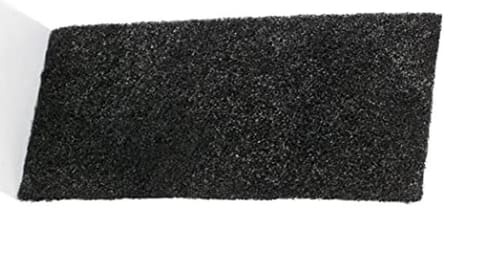
The activated-carbon filter padReplaceable media, held behind the front grille.
01 / Particles
Capture through the media.
Particle filtration involves collecting airborne particles as air passes through a filter. Performance depends on the media, particle size, fit, and airflow.
02 / Activated carbon
A different mechanism.
Certain gas molecules can bind to the surface of activated carbon through adsorption. The amount of carbon and the conditions matter; a carbon pad does not remove every odor or gas.
03 / Airflow
Resistance matters, too.
Air must move through the filter. Pressure differential measures the resistance across it. The condition of the filter and the system it is installed in both matter.
03How we testMethods & scope
Different tests. Different questions.
Each type of testing answers a specific question. Here is what has been evaluated and how to interpret the work.
Bench testing
Airflow resistance
An independent laboratory measured pressure differential across a clean filter pad sealed in a laboratory duct fixture, at four duct airflows.
Test completed
The results concern the tested pad. Numerical results remain unpublished while the tested pad is reconciled with the current production filter.
Controlled chamber
Particle & gas testing
The study compared airborne particle and gas concentrations with the return-vent filter against a no-filter control. See lab results, including the measurement conditions above.
Report available
The results and full report are available on this page. They describe the tested configuration and measurement period.
In-use observations
Filter loading & system pressure
Residential and office observations track filter loading and system pressure during use. These observations help frame questions for further evaluation.
Internal observations
These records are not presented as independently verified performance evidence.
04Put the science to workFit & maintenance
Good filtration starts with good fit.
Measure the duct opening. This product is designed for an exact horizontal 14″ × 6″ wall-return opening.
Keep your primary HVAC filter in place and follow the system manufacturer’s guidance. Ask an HVAC professional about system compatibility.
Inspect the return filters around every 90 days. Pets, projects, and system runtime can change how quickly a filter loads.
It is the difference in air pressure across a filter. It describes airflow resistance under the test conditions. A pad measurement alone cannot establish the behavior of an entire installed HVAC system.
What does activated carbon do?
Activated carbon provides a surface on which certain gas molecules can bind. Its effectiveness depends on the compound, the amount of carbon, and the operating conditions. We do not claim removal of every gas or odor.
Does this replace the furnace filter?
No. The return grille adds pre-filtration at the room’s return opening. Continue to use and maintain the primary filter specified for your HVAC system.
How does filtration fit into indoor air care?
Reducing pollutant sources and ventilating with clean outdoor air remain important. Filtration is an additional measure, and no filter removes every indoor pollutant.
Read the complete report prepared in partnership with Aerosol Research and Engineering Laboratories, including the study methods, tested configuration, and measurement results.
Have a question about a test method, filter media, or your installation?